Posted April 15, 2026
The Christophers: Preview Club Wrap-Up
by JBFC Film Programmer Ian LoCascio
As part of the JBFC Preview Club, subscribers get an exclusive first look at the most interesting new indies and foreign films on our “New Releases” horizon. Every month, JBFC programmers present a special “secret” screening of an anticipated new film release before it is available to the public. After the screening, our programmers open the floor for a robust audience discussion and send Club members a wrap-up note with behind-the-scenes details and fun facts about the film they just watched.
As a special treat, we have decided to make these notes public. Beware, there may be spoilers!
Preview Club Wrap-up for The Christophers, presented by JBFC Film Programmer Ian LoCascio on Apr. 8, 2026:
Thank you for joining me for a lovely Preview Club screening on Tuesday!
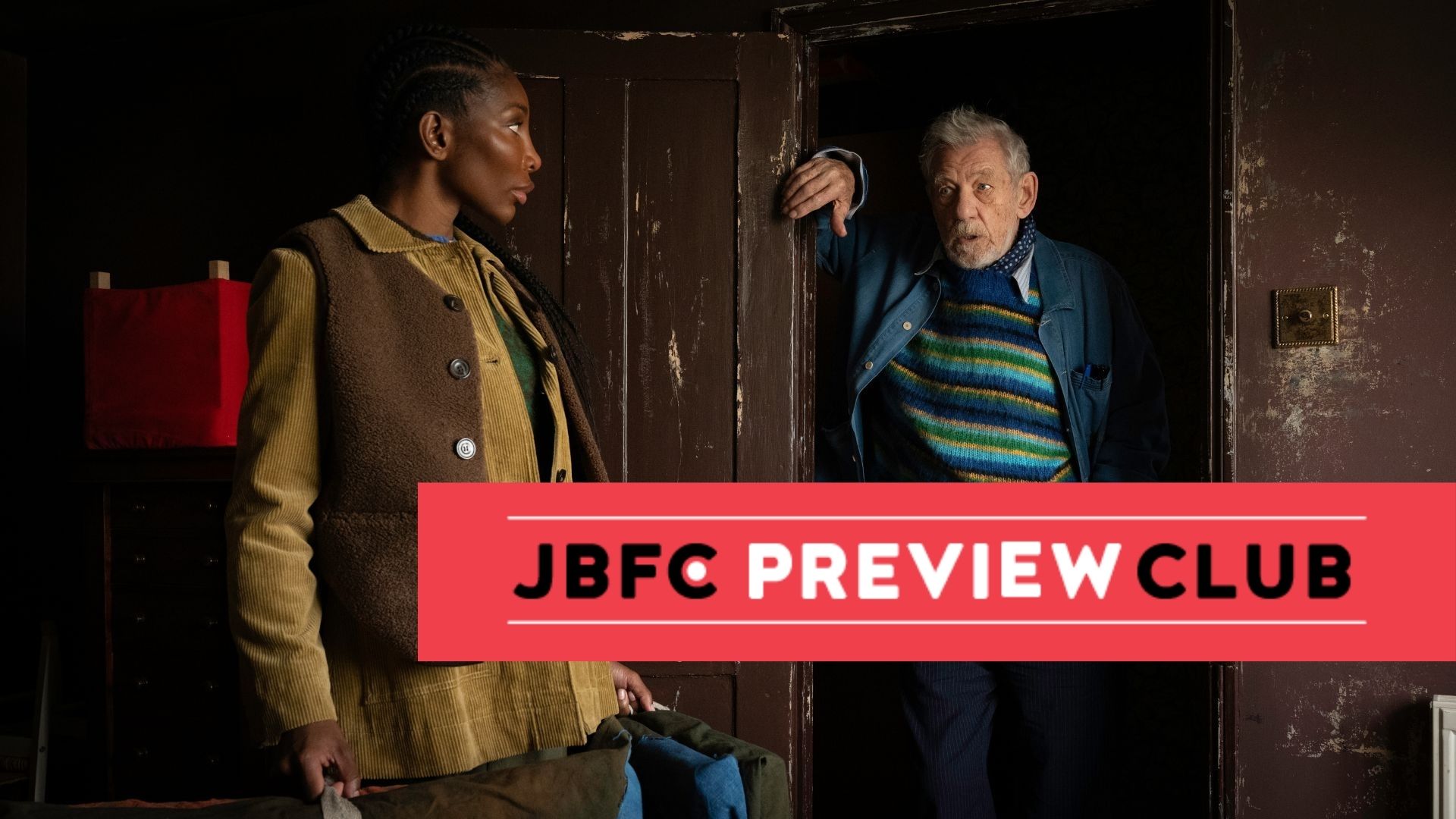
This month’s film was The Christophers, directed by Steven Soderbergh, which we open at the Burns on Friday, April 17, courtesy of our friends at NEON.
The Christophers is the 33rd feature film to be directed by Soderbergh, who made his narrative filmmaking debut with Sex Lies and Videotape, which was awarded the Palme d’Or at the 1989 Cannes Film Festival, making the then-26-year-old Soderbergh the youngest filmmaker to ever win the top prize at Cannes.
Soderbergh is considered one of the pioneers of the American independent cinema movement, which blossomed across the 1990s, and which also included filmmakers Quentin Tarantino, Paul Thomas Anderson, Jim Jarmusch, Kevin Smith, David O. Russell, and Ethan & Joel Coen. It’s impossible to mention this period, and these filmmakers, without also mentioning the establishment of the Sundance Film Festival. Although it didn’t start going by the name Sundance until 1991, the festival had existed under previous names stretching as far back as 1978, and was known as the U.S. Film Festival when it hosted the world premiere of Sex Lies and Videotape in 1989. Over the course of the 90s, Sundance went on to launch the careers of many of the filmmakers mentioned above.
While Soderbergh’s post-Sex Lies and Videotapes output across the 90s was relatively polarizing, the release of his film Out of Sight in 1998 was significant, not only because it was the first of many collaborations between Soderbergh and George Clooney, but also because it marked the beginning of what I consider to be one of the best five film runs in contemporary cinema history. Soderbergh followed up Out of Sight with his crime drama The Limey, which features a career-best performance from British actor Terrence Stamp, in 1999. He then followed up The Limey with both Traffic and Erin Brockovich in 2000, closing out with Ocean’s 11 in 2001.
I think it’s fair to say that any of those five films would stand on their own as a clear high point in any filmmaker’s body of work, but the fact that all five were released across the same four-year period is nothing short of astonishing to me. It feels right that, following Soderbergh’s dual Best Director nominations at the 2001 Academy Awards (for Traffic and Erin Brockovich respectively), he still stands as the most recent filmmaker to receive two Best Director nominations in the same year. He ultimately went on to win the Oscar for Traffic and, in doing so, gave this rather wonderful Oscar acceptance speech.
Soderbergh then went on to direct 16 feature films between the years 2002 and 2013 when, following the release of Behind the Candelabra—his HBO film about Liberace starring Michael Douglas and Matt Damon—he announced that he planned to retire from filmmaking. During his “retirement” period, he directed all 20 episodes of the Cinemax series The Knick, which starred Clive Owen and André Holland, before announcing his return to filmmaking in 2017. Since the end of his brief retirement period, Soderbergh has directed 11 feature films, with The Christophers being his most recent.
All of this is to say that Soderbergh is nothing if not prolific, and I find that filmmakers who work as frequently as Soderbergh tend to fall into one of two camps. In the first camp, you have a filmmaker like the brilliant South Korean director Hong Sang-soo, who also premiered his 33rd film, What Does That Nature Say to You, last year, and whose films are often exercises in small adjustments to recurring scenarios, structures, and formulas. The “Hong Sang-soo movie” is almost a genre unto itself at this point, and part of the immense pleasure of immersing oneself in his body of work is seeing the small ways he subverts and upends these familiar components with each new film. Then, on the other hand, you have a filmmaker like Soderbergh—whose films, particularly in his post-retirement era, have the tendency to lurch from one genre to another in such a way that seems designed to upend one’s understanding of what a “Steven Soderbergh movie” even looks like to begin with.
Of the three most recent Soderbergh films to be released in theaters—you have Presence, a ghost story set in a haunted house, which was released in theaters last January; you have Black Bag, a sexy espionage romance, which was released in theaters last March; and you have The Christophers, a gently comedic art-world chamber drama which seems, at least on its surface, to be the least conventional “Soderbergh Movie” that Soderbergh has released in recent memory. Though with that said, I do think The Christophers is less of a strange bedfellow within Soderbergh’s filmography than immediately meets the eye.
A theme which has remained constant throughout Soderbergh’s body of work is the art of deception, which I think manifests itself not only in the many criminals who have populated Soderbergh’s oeuvre, with George Clooney’s Danny Ocean standing as perhaps the most iconic cinematic criminal of the 21st century, but also in the artists and performers he’s chosen to focus on—from Channing Tatum’s Magic Mike to Michael Douglas’s Liberace to Sir Ian McKellan’s Julian Sklar to Michaela Coel’s Lori Butler—Soderbergh’s work often demonstrates a great sense of admiration for the art of artifice.
One of my favorite sequences in any of Soderbergh’s films, and one which I think speaks quite well to this recurring fascination of his, comes in Ocean’s 12, the sequel to Ocean’s 11, when the character of Tess, played in the film by Julia Roberts, is tasked with dressing up as her celebrity doppelgänger, Julia Roberts, in order to be granted VIP access to the building that Danny Ocean and co. are trying to rob. So Julia Roberts plays a character who is disguising herself as Julia Roberts, only to run into Bruce Willis, who is playing himself, and the heist is imperiled as Tess has to try and stay in character as Julia Roberts to trick Bruce Willis into thinking she is, in fact, Julia Roberts. Just as The Christophers explores the thin line between the artist and the forger, that scene in Ocean’s 12 cracks open the world of the film and, in addition to being a hilarious and shockingly suspenseful scene, raises some very similar questions.
The Julia Roberts sequence in Ocean’s 12 is also a testament to the fact that Soderbergh is a technically proficient and formally audacious filmmaker with a borderline experimental approach to commercial filmmaking, so it’s striking how gentle his directorial touch in The Christophers is, compared not only to films like the “Ocean’s Trilogy,” but to the rest of his post-retirement films as well. Soderbergh has talked about how he made the deliberate choice to shoot nearly all of the scenes in Julian’s townhouse and studio using handheld cameras to help embody the instability that Lori feels when she’s there, whereas all of her scenes outside of Julian’s house are shot using tripods and dollies. It’s only when Lori returns to the townhouse at the end of the film, after Julian has passed away, that Soderbergh begins shooting those interiors on a mounted camera, wanting the audience to sense that something has shifted in Lori’s relationship to the townhouse, without necessarily being able to discern what the change was.
Before shooting the film, Soderbergh and screenwriter Ed Solomon went through the script line by line with the film’s actors, Sir Ian McKellen and Micaela Coel, so as to ensure that each line made sense to them and felt organic. By the time that they began shooting, which, at 18 days, was a relatively brief shoot, Soderbergh says that he tried to keep any notes he gave the actors from being too heady and intellectual, instead focusing on physical elements of their performances. With this, Soderbergh hoped that, as dialogue-heavy as the film is, it could be watched without any sound—and the story of their relationship could be told entirely through their physicality, combined with the staging, framing, and editing patterns.
The film’s credited cinematographer, Peter Andrews, is a pseudonym of Steven Soderbergh’s, who served as the film’s cinematographer and camera operator, and the film’s credited editor, Mary Ann Bernard, is yet another pseudonym of his. He has shot and edited each of the fifteen feature films he’s directed since Haywire in 2011, and says that he considers the ability to immerse himself in the process and “work more quickly with fewer people” to be the greatest benefit that contemporary technological advancements have afforded him as a filmmaker. I think it’s striking that, in recent years, Hong Sang-soo, the similarly prolific South Korean filmmaker I mentioned earlier, has also shifted to shooting and editing the films he directs, having served as cinematographer and editor on each of the ten films he’s released since 2021.
In Soderbergh’s words: “In mainstream cinema, the pushing of boundaries that we saw for a couple of decades has disappeared. And we’re sitting in a grammar that peaked a while ago. There are two reactions to that. You can quit, or you can do something that (The Christophers) is trying to do: distill things to their absolute essence and just focus on a story that specifically you haven’t told before.”
While back when he announced his retirement from filmmaking, it seemed like Soderbergh might go with the first option and leave filmmaking behind, I’m glad he’s since decided to go with the second option and keep making movies. After 33 films and nearly four decades in the business, I think Soderbergh remains a bold, exciting, and consistently surprising artist—and I can’t wait to see what he does next.
I hope you enjoyed The Christophers, and I look forward to seeing you next month!
Best,
Ian
The Christophers opens for a run at the JBFC Theater on Friday, April 17.
Want to stay up to date on what’s happening at the JBFC? Make sure to sign up for our ebulletin HERE.