Posted November 12, 2026
Paper Tiger: Preview Club Wrap-Up
by JBFC Film Programmer Ian LoCascio
As part of the JBFC Preview Club, subscribers get an exclusive first look at the most interesting new indies and foreign films on our “New Releases” horizon. Every month, JBFC programmers present a special “secret” screening of an anticipated new film release before it is available to the public. After the screening, our programmers open the floor for a robust audience discussion and send Club members a wrap-up note with behind-the-scenes details and fun facts about the film they just watched.
As a special treat, we have decided to make these notes public. Beware, there may be spoilers!
Preview Club Wrap-Up for Paper Tiger, presented by JBFC Film Programmer Ian LoCascio on Tuesday, Nov. 10, 2026:
Hi all,
Thank you for a wonderful penultimate screening of this season of Preview Club!
I look forward to returning as host of Preview Club again next season and, as a reminder, subscriptions are now on sale for members at the Film Sponsor, Film Enthusiast, and Silver Screen Circle level—with subscriptions for members at the Film Buff level set to go on sale on Monday, Nov. 16.
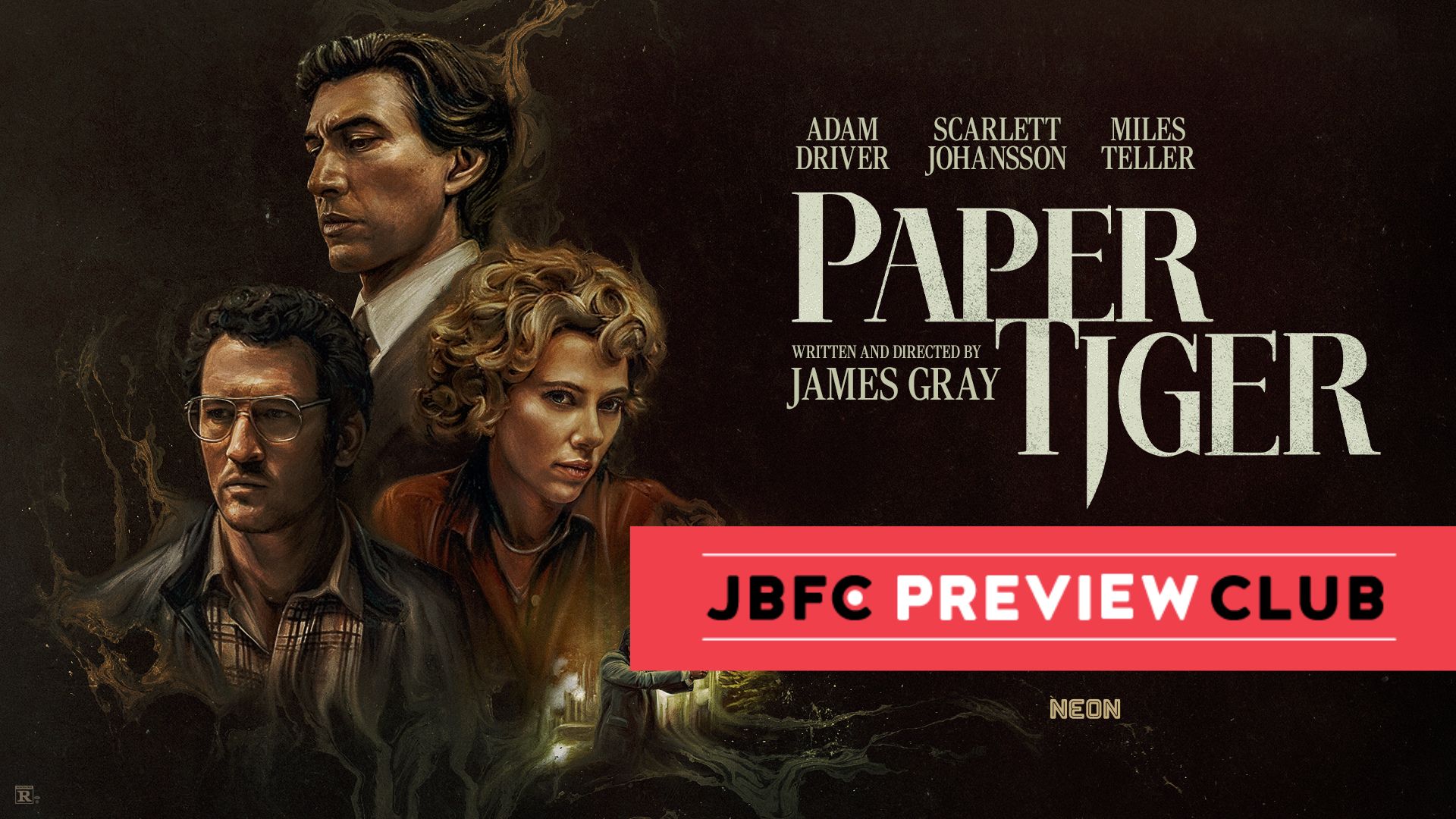
This month’s Preview Club film was Paper Tiger—which we’ll open for a run at the Burns on Wednesday, Nov. 25, courtesy of our friends at NEON.
Paper Tiger was directed by James Gray and had its world premiere at the Cannes Film Festival earlier this year, where it was Gray’s sixth film to premiere in competition. The film then had its North American premiere as the Opening Night gala at the New York Film Festival, which I think was only right because, among other things, Gray is one of our greatest cinematic chroniclers of New York City.
As I mentioned on Tuesday, six of the nine feature films Gray has directed have been set in New York City. Of the two exceptions, 2016’s The Lost City of Z is set in the Amazon Rainforest, while the second, 2019’s Ad Astra, is set almost entirely in outer space. All of which is to say that, on the rare occasion James Gray makes a movie set outside the New York City limits, he seems to make a point of setting that movie far outside the New York City limits.
Gray was born and raised in Flushing, Queens and, although Paper Tiger is a work of fiction which Gray has described as being a “Hitchcockian thriller,” he has also said that approximately 90% of what happens in the film was taken from incidents and memories from his and his family’s past. Irwin Pearl, played by Miles Teller, is directly modeled after Gray’s father, an electronics salesman who, in his attempts to provide for his family, fell into legal troubles and wound up a convicted felon. The bulk of James Gray’s films set in New York City have been crime films in some shape or form, and he has spoken about how the crime element of his work isn’t “grafted on for effect,” but is a part of his life experience which inevitably works its way into his films.
One of the most pivotal scenes in Paper Tiger is the scene at the Gowanus Canal when Irwin brings his kids to see what he’s been working on, which is the inciting incident for pretty much everything that happens in the film from that point onward. That scene is drawn from Gray’s own memories of being held at knife point, along with his brother, in the back of their own family car. He has discussed still being able to recall every detail—from the smell of the seats, to the sound of the subway in the distance, to the way the fog on the windows obscured what was happening outside the car—and he endeavored to bring as much of that visceral detail to the scene as he could.
Gray has described Adam Driver’s character, Gary Pearl, as a composite character which blends his uncle with a former business partner of his father. While neither of them died quite as dramatically as Gary does, the idea for the incredible shootout leading up to Gary’s death, set in the tall grass near LaGuardia airport, is drawn from a traumatic experience James Gray had as a child, when he and his brother got lost in that same tall grass. Although they were not being pursued by Russian gangsters like Gary is in the film, the filmmaker has described those memories of getting lost in the grass as “a recurring nightmare.” If any of you have seen James Gray’s excellent film We Own the Night, from 2007, you may recognize that tall grass from a similar shootout at the end of that film; and I think it’s worth noting that there are a number of themes, ideas, scenarios, and images which Gray has returned to over the course of his filmography.
Although they make very different movies with very different aesthetic sensibilities, James Gray is an avowed fan of the great Italian filmmaker Federico Fellini. Gray has talked about drawing inspiration from the way that Fellini would return to similar stories, ideas, and images over the course of his own filmography—specifically citing the way that Fellini’s autobiographical masterpieces I Vitelloni (1953) and Amarcord (1973) are, despite being released two decades apart, essentially two sides of the same coin, with both films finding Fellini looking back on many of the same memories of his adolescence in Rimini.
Hester Pearl, Scarlett Johannson’s character in Paper Tiger, was inspired by James Gray’s mother who, like Hester, was diagnosed with and quickly died from brain cancer when Gray was young. The tragic loss of Gray’s mother is something which has hung over his body of work, beginning with his first film, Little Odessa, in which Vanessa Redgrave plays the terminally ill mother of the film’s protagonist; and, in his second film, The Yards, where Ellen Burstyn plays the terminally ill mother of that film’s protagonist.
Still, the most overtly autobiographical of Gray’s films is 2022’s Armageddon Time, a coming-of-age film directly inspired by Gray’s own childhood, which is set at the dawn of the Reagan Era and centers on an 11-year-old boy growing up in Flushing. In that film, the stand-ins for Gray’s parents are played by Jeremy Strong and Anne Hathaway, and Gray initially conceived of Paper Tiger as a direct sequel to Armageddon Time, with Strong and Hathaway set to reprise their roles. However, due to scheduling conflicts, Gray ultimately opted to cast Miles Teller and Scarlett Johansson instead.
Another recurring motif in James Gray’s films, most of which are set in the “outer boroughs” of Queens or Brooklyn, is the seemingly inescapable presence of airplanes flying overhead, which was the case throughout Gray’s childhood. When he was location scouting for Armageddon Time, Gray visited the school he attended growing up and, struck by the frequency of the planes passing above the school, he set a stopwatch to track just how often a plane flew by. He found that the average time between planes was 38 seconds. Gray recalls the air of his childhood always reeking of jet fuel, and it’s a memory which has led him to contemplate the origins of his mother’s illness. In making Paper Tiger, Gray has said that he views Hester’s cancer as the “physical manifestation” of the chemicals being dumped at the Gowanus Canal, as well as from the planes above, saying that “the ecological catastrophe we created is the perfect physical manifestation of the corruption of our souls.”
The end of Paper Tiger reminds me a bit of the opening scene of David Lynch’s Blue Velvet, where you have establishing shots of a small, idyllic, American-as-apple-pie town, until the camera sinks beneath the green, perfectly manicured grass and reveals the dirt and bugs lurking below. At the end of Paper Tiger, Irwin has no idea that his brother is dead and his wife will soon follow. Instead, he seems to be living the American Dream—with his promising business, his beautiful home, his beloved nuclear family, and his luxury car—but, if it took the quintessential combination of blood, sweat, and tears for Irwin to get there, the film seems to ask the question of: whose blood? And whose sweat? And whose tears?
Paper Tiger opens with a quote from the play Agamemnon by Aeschylus, which reads: “let there be wealth without tears; enough for the wise man who will ask no further,” and that quote really does speak to the heart of the film. James Gray’s films are often described as being “classical,” and, as I said on Tuesday, I think that there are multiple layers to that classicism.
Narratively, Gray wastes no time in alluding to Greek tragedy with that quote from Agamemnon, the first play in Aeschylus’s monumental Oresteia. Gray has said that his “classical education allowed [him] to discover Greek tragedy and its fascination with family relationships” and his “taste had been shaped very early on by this belief that family life is an endless and unique source of drama that will never go out of fashion.”
Cinematically, Gray cites Alfred Hitchcock’s thrillers as being especially influential on Paper Tiger, with Hitchcock’s 1956 remake of The Man Who Knew Too Much serving as a significant reference point. Gray also made a point of shooting Paper Tiger on 35mm film, like films from the 80s would have been, in addition to using vintage lenses and lighting to help give it a tangible sense of period accuracy.
Musically, the score for the film was composed by Christopher Spelman, who was also Gray’s Latin teacher in school. Spelman’s work was influenced by the music of legendary composer Giacomo Puccini, particularly a post-Romantic Italian operatic tradition called “verismo,” which focused on everyday realism and endeavored to bring dignity to the stories of “ordinary people” at a time when most stories were about kings and queens.
With Paper Tiger, James Gray blends the intimate with the operatic, the hyper-specific with the universal, and, in rewriting his own family history within the framework of a 20th century Greek tragedy, he made what I consider to be among the best American films of the year.
I hope you enjoyed Paper Tiger, and I’ll see you next time!!
Best,
Ian
Paper Tiger opens for a run at the JBFC Theater on Wednesday, Nov. 25, and advance tickets are on sale now.
Want to stay up to date on what’s happening at the JBFC? Make sure to sign up for our ebulletin HERE.