Posted June 2, 2026
Every 35mm Print Tells a Story
What You’re Seeing Isn’t a Flaw
There’s a moment that sometimes happens during a 35mm screening: a flicker, a faint vertical line, a brief flash in the corner of the image. If you’re used to digital film projection, it can feel like something has gone wrong.
It hasn’t. In fact, something rare and meaningful is happening.
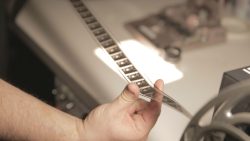
What you’re seeing is not a glitch, but evidence. Evidence that the film you’re watching is physical, that it has moved through time and space, and that it carries a history that predates this single screening. Every print carries a story. These one-of-a-kind prints, even under the best conditions, pick up small imperfections with each projector they pass through. Some of that wear may have happened decades ago in theaters that no longer exist, but the film strip carries the memory.
A Vanishing Art
Most theaters no longer offer screenings on 35mm film. The industry’s shift to digital projection over the past two decades has been sweeping, and for many venues, 35mm projection is simply gone; the equipment sold off, the expertise retired, the tradition discontinued.
The Burns pursued a different path.
Most of our projection is digital, and we value what that format makes possible. But there is something irreplaceable about 35mm: a texture, a tangible warmth; a sense of presence that no digital file can fully replicate. When we do show analog film, it is not out of nostalgia, but out of care and conviction.
Showing 35mm today is not the path of least resistance. It requires specialized equipment, much of which is no longer in production and must be sourced from old warehouses, shuttered theaters, and private collections. It is not just the film reels that are disappearing or degrading; the technology required to project them is as well. 35mm prints are harder to find, cost more to rent, and require extra staffing and effort to offer.
The People Behind the Projection Booth
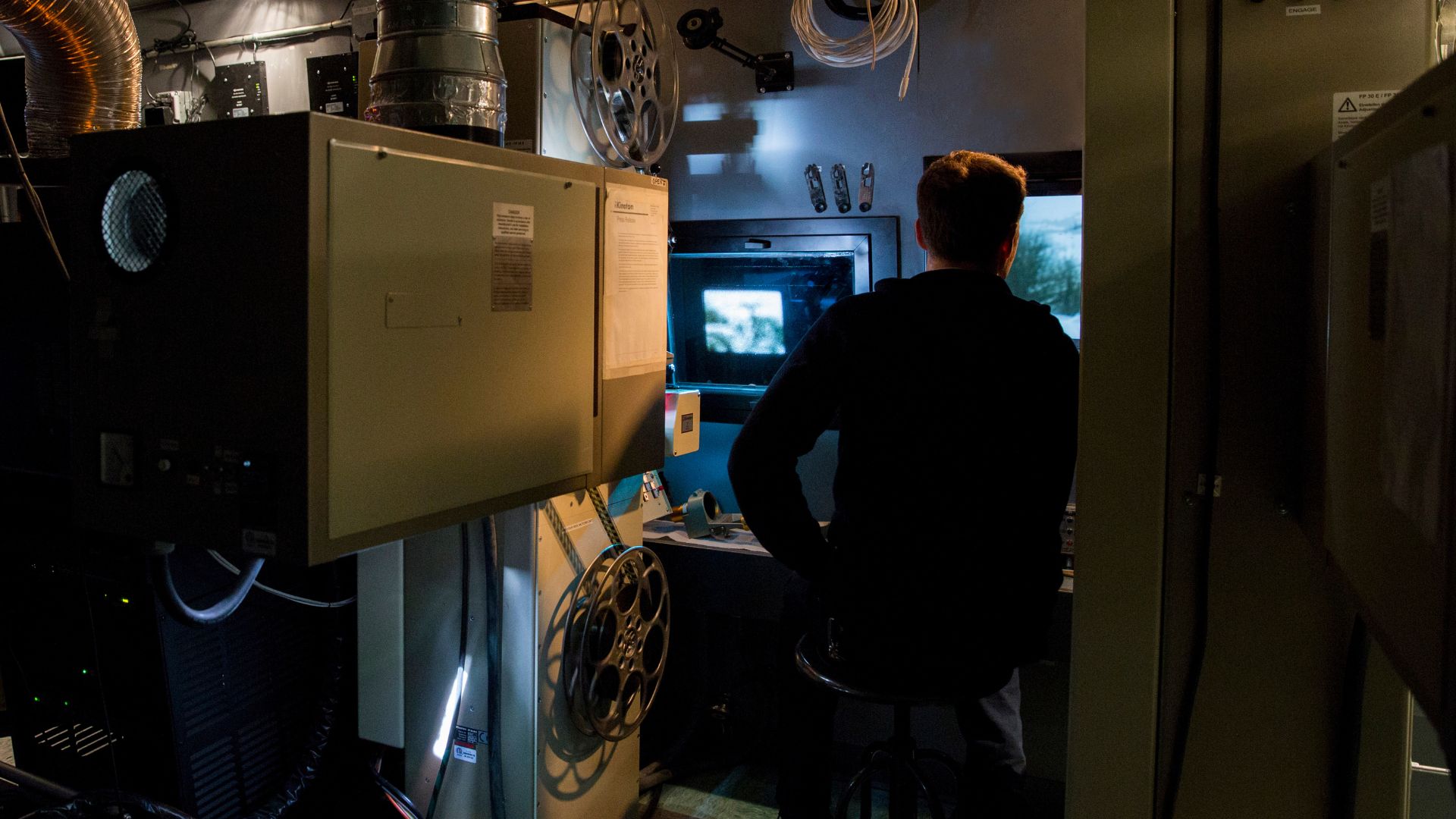
The Burns’ commitment to preserving 35mm projection is bolstered by the dedication of our projectionists.
Our projection staff brings more than 50 combined years of experience to the booth. That depth of knowledge is increasingly rare, perhaps even endangered. These are projectionists who have spent careers understanding not only the equipment, but also the medium itself: how a print chainages, how it behaves under different conditions, how to read its quirks, anticipate issues, and respond to them in real time.
Technical Director Andrew Robinson has thought deeply about what that work means: “We are the technical purveyors of an art,” he explains. “What we do sits at the intersection of presentation and preservation. These prints have lived lives before they reach us, and they will continue on after. Our job is to care for them at that moment, to understand their condition, and to present them with the respect they deserve. It’s our technical expertise that allows this form of art to be conveyed.”
This is not a skill you acquire quickly. It is built over years of attentive, hands-on work, and it is exactly the kind of expertise that disappears when institutions stop prioritizing analog formats.
A Print’s Journey, Made Visible
A 35mm print carries with it more than just a film—it contains a chain of stewardship. Each mark, each splice, each careful repair is a trace of the people who have handled it in the past, projectionists and technicians who have done their part to preserve it and pass it along. What arrives in our booth represents the accumulated care of countless others precious cargo entrusted to us to carry forward into the future.
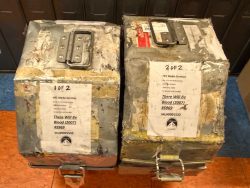
That journey–with all its trials and tribulations–became especially prescient in the lead-up to our recent sold-out screening of There Will Be Blood.
When The Burns shared a photo of the arriving 35mm cans on social media, Kevin Rooney, former Head Projectionist at Film Streams in Omaha, Nebraska, recognized them immediately: He had run that exact same print just months earlier. Kevin reached out to our team and, in a gesture that speaks to the tight-knit nature of the projectionist community, offered to send along his prior inspection report.
What arrived was a single handwritten page, but it told a story. For example, several reels had accumulated tape residue near the ends, and needed to be cleaned before they could rewind without slipping. Each note was evidence of the care Kevin and his team had put into the print before passing it on, so that the next audience, in a state and city far away, could experience the film as it was meant to be seen.
Why Imperfection Matters
There is a reason people seek out live music over streaming, handmade artisan objects over mass-produced goods. The imperfection of a film is not incidental. It is the proof of presence, of people, of passion. With 35mm, you are not watching a copy of a movie. You are watching this print, in this room, on this night–and, in all likelihood, may never see it that way again.
That is the kind of experience that creates long-lasting memories. Without a doubt, it is an experience worth preserving.
Showing Up for the Format
The Burns projects the majority of its films digitally, allowing us to offer a wide range of programming to our audience. At the same time, having three distinct theaters capable of 35mm projection places us in rare company among our peers.
When a film is presented on 35mm, there is a heightened sense of occasion: a quiet awareness that what is unfolding on screen is specific to this moment, this print, this audience. It will never be experienced the same way twice–and it certainly can’t be replicated at home.
That experience requires equipment that is increasingly scarce. It requires expertise built over decades. And it requires an institution willing to make the commitment to preserving our cinematic history even when an easier path exists.
Preserving experiences like these does not happen by accident. It takes investment, care, a commitment to keeping this art form alive for future audiences, and an awareness of the responsibility and privilege that comes with serving as stewards of our cinematic and cultural history. As a nonprofit, The Burns relies on the support of our community to sustain our deeply meaningful work. If moments like these matter to you, we invite you to make a contribution and help ensure that analog film, and all the stories it carries within each frame, continue to be seen, shared, and preserved–together.