Posted October 20, 2026
A Talent for Murder: Preview Club Wrap-Up
by JBFC Film Programmer Ian LoCascio
As part of the JBFC Preview Club, subscribers get an exclusive first look at the most interesting new indies and foreign films on our “New Releases” horizon. Every month, JBFC programmers present a special “secret” screening of an anticipated new film release before it is available to the public. After the screening, our programmers open the floor for a robust audience discussion and send Club members a wrap-up note with behind-the-scenes details and fun facts about the film they just watched.
As a special treat, we have decided to make these notes public. Beware, there may be spoilers!
Preview Club Wrap-up for A Talent for Murder, presented by JBFC Film Programmer Ian LoCascio on Tuesday, Oct. 6, 2026:
Hi all,
This month’s Preview Club film was A Talent for Murder, which we open for a run on Friday, Oct. 23, courtesy of our friends at Bleecker Street.
The film had its world premiere at the Toronto International Film Festival. It was directed by Anton Corbijn—the Danish filmmaker behind 2008’s Control, a biopic about Joy Division frontman Ian Curtis; 2010’s The American starring George Clooney; and 2014’s A Most Wanted Man, an adaptation of the eponymous John Le Carré novel starring Philip Seymour Hoffman in one of his final on-screen performances.
A Talent for Murder is an adaptation of Joanna Murray-Smith’s 2014 play Switzerland, which was written and staged as a two-actor (though perhaps not two-character) chamber drama between Patricia Highsmith and Edward Ridgeway, the precocious emissary of Highsmith’s publisher, who increasingly resembles Highsmith’s iconic character Tom Ripley as the play progresses.
Producer Gabrielle Tana, a voracious reader of Highsmith’s work, came across the play and immediately saw its cinematic potential, which led her to reach out to playwright Joanna Murray-Smith and, ultimately, to sign on to produce the film adaptation. Tana worked with Murray-Smith to adapt the play and “open up the world of the story” as it moved from the stage to the screen, while still maintaining what Murray-Smith described as the “cat-and-mouse intensity” of the film’s source material.
This began with the hiring of Anton Corbijn to direct the film, as Murray-Smith felt that it needed a director who could draw out the visual and sonic landscape to complement the film’s dialogue-heavy screenplay. Corbijn had spent eight years turning down every script he was offered because none of them felt “right,” but he was immediately struck by the script for A Talent for Murder. Another point of attraction for Corbijn was the fact that The American Friend, Wim Wenders’ excellent adaption of Highsmith’s third Ripley book, is one of his favorite films. It is, indeed, a great one!
I don’t think it is terribly controversial to say that Tom Ripley is one of the all-time great characters of the page and screen alike, which explains why so many great actors have chosen to play him, including Alain Delon in 1960’s Purple Moon, John Malkovich in 2002’s Ripley’s Game, Andrew Scott in the 2024 mini-series Ripley, Matt Damon in 1999’s seminal The Talented Mr. Ripley, and Dennis Hopper in 1977’s The American Friend.
As I discussed last week, I think there are many reasons why an actor would be drawn to the role of Tom Ripley, but an element of Ripley’s character which I find to be of considerable interest is the extent to which he is, himself, an actor. I was struck by this passage from Highsmith’s first Ripley novel, The Talented Mr. Ripley: “He hated becoming Thomas Ripley again, hated being nobody, hated putting on his old set of habits again, and feeling that people looked down on him and were bored with him unless he put on an act for them like a clown, feeling incompetent and incapable of doing anything with himself except entertaining people for minutes at a time,” and I can easily envision how an actor could read that and relate!
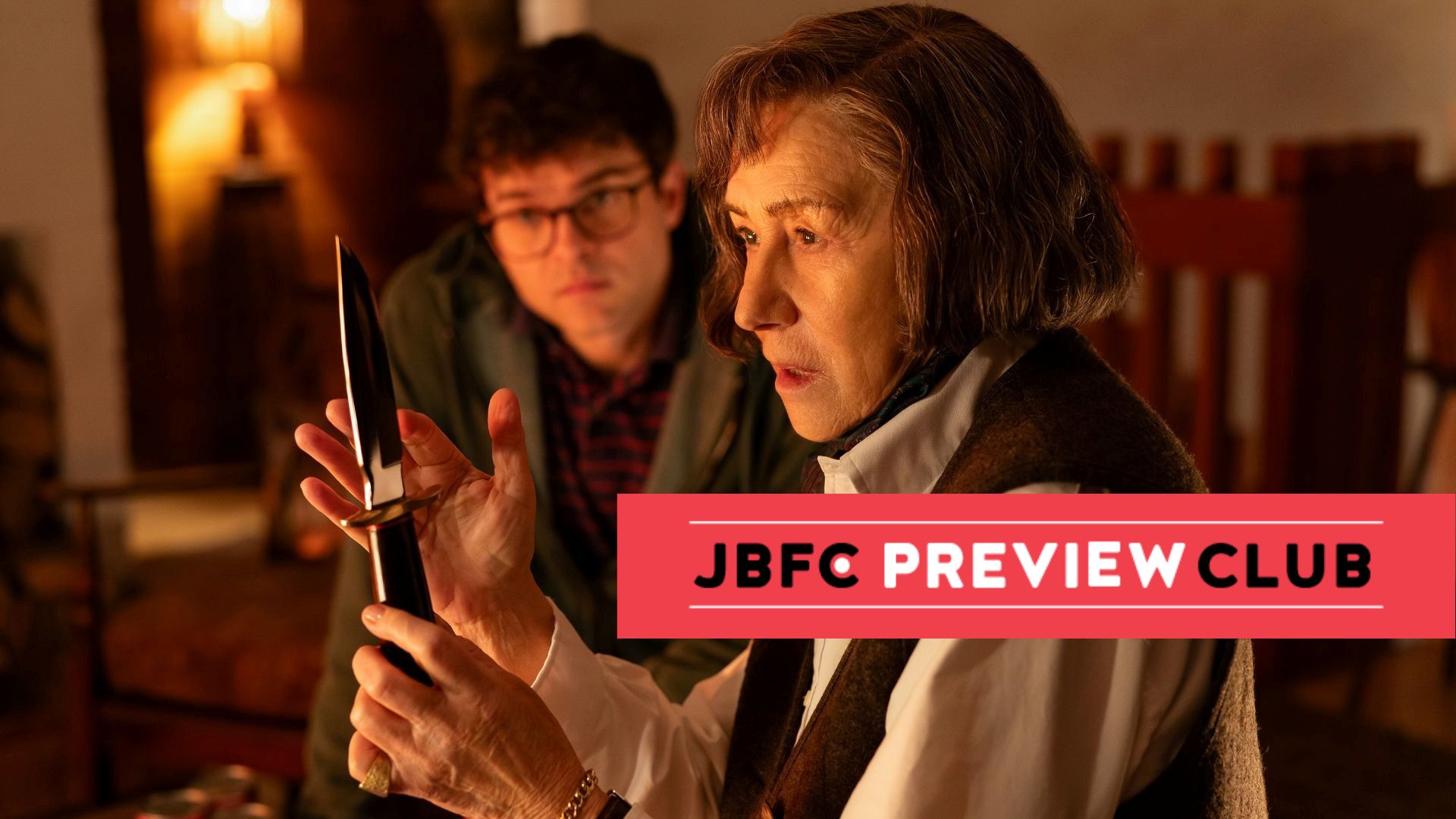
In A Talent for Murder, we have freshly-minted Tony winner Alden Ehrenreich in the dual role of Arthur Ridgeway and Tom Ripley, with the nature of the dual performance being a large part of what drew him to the role. Ehrenreich has discussed approaching Ridgeway and Ripley as two entirely distinct characters who are being channeled through the same person. This was also a welcome challenge for the film’s makeup, hairstyling, and costuming departments as they set out to articulate subtle differences between the two characters, especially as the film progresses and the question of who Ehrenreich is playing at any given moment feels less clear.
Ehrenreich is lucky to spend much of the film sparring with one of the all-time great scene partners in the great Helen Mirren, who has described the shoot of A Talent For Murder as being one of the most intense experiences she’s ever had making a movie, but commended Ehrenreich for “understanding that there’s a partnership” and “that you are reliant upon each other in performing this.”
The film’s undeniable and unabashed fictionality was also a selling point for Mirren, who has said that “we are not making a documentary about Patricia Highsmith. We are not even making a docu-drama about Patricia Highsmith. She is a character within a story that is a mystery, a thriller, a psychological investigation—not unlike her novels—one that’s obviously very inspired by her writing. It is not a literal presentation of the last days of her life at all. It’s a journey into the imagination.”
Still, despite some significant creative liberties, the film didn’t entirely forgo research into Highsmith—with the set design for Highsmith’s home being rooted in extensive research into what her home in Switzerland—where she lived until the end of her life—would have looked like at that time. The custom-designed building is still standing, and the production visited it, but contemporary expansions and the fact that it is now surrounded by other houses precluded them from using Highsmith’s actual house for the secluded bunker you saw in the film.
Not wanting to build a set, the production team found an actual residential home in England, which they emptied out and redecorated for the shoot. This team, led by designer Dimitri Capuan, were painstaking in their recreations—referencing archival photos of Highsmith’s home and the many unusual items she collected, as well as manually copying all of Highsmith’s notebooks by imitating her handwriting.
The choice to shoot in the relatively small residential home that you see in the film presented the film team with its share of challenges. If any of you attended last October’s Preview Club screening of Blue Moon starring Ethan Hawke, you may recall that I talked about that production building of a set replica of Sardi’s, where the film takes place, complete with physical trenches to maneuver the camera—but the film crew had no such luxuries here, instead having to make do with a shoot in close quarters.
Luckily, A Talent for Murder was shot by the great Robbie Ryan, an exceptional director of photography as deft at shooting big, grand films like Yorgos Lanthimos’ Poor Things as he is at shooting small, intimate films like Andrea Arnold’s Fish Tank, Ken Loach’s I Daniel Blake, and Mike Mills’ C’mon, C’mon.
In A Talent For Murder, we find Robbie Ryan working both muscles—bouncing from the cramped, isolated corners of Patricia Highsmith’s home to mountain vistas and ornate villas—without sacrificing any sense of tension or atmosphere. Last year Robbie Ryan re-teamed with Yorgos Lanthimos on his film Bugonia, and I think Ryan struck a similar balance there, wherein he made a film mostly shot in a very claustrophobic house still feel undeniably cinematic.
Alden Ehrenreich, who plays Ridgeway, has noted how spontaneous Ryan’s process as a cinematographer is, with Ehrenreich describing Ryan as focusing more on his intuition in the moment than remaining beholden to his plans and shot-lists. This sense of openness to discovery extended beyond the film’s camera work, with screenwriter and playwright Joanna Murray-Smith present on set every day, where she treated the film’s actors like true collaborators, and encouraged them to act upon their own intuition and suggest changes to the text.
Ultimately, I found this film to be a strong showcase for its very talented ensemble of actors and craftspeople, as well as an enjoyable tribute to one of the great characters in contemporary fiction and the writer who brought him into this world. 71 years after the publication of The Talented Mr. Ripley, Tom Ripley is clearly here to stay.
I hope you enjoyed the film, and I’ll see you next time!
Best,
Ian
A Talent for Murder opens for a run at the JBFC Theater on Friday, Oct. 23.
Want to stay up to date on what’s happening at the JBFC? Make sure to sign up for our ebulletin HERE.