
Posted February 6, 2026
The Love That Remains: Preview Club Wrap-Up
by JBFC Film Programmer Ian LoCascio
As part of the JBFC Preview Club, subscribers get an exclusive first look at the most interesting new indies and foreign films on our “New Releases” horizon. Every month, JBFC programmers present a special “secret” screening of an anticipated new film release before it is available to the public. After the screening, our programmers open the floor for a robust audience discussion and send Club members a wrap-up note with behind-the-scenes details and fun facts about the film they just watched.
As a special treat, we have decided to make these notes public. Beware, there may be spoilers!
Preview Club Wrap-up for The Love That Remains, presented by JBFC Film Programmer Ian LoCascio on Feb. 3, 2026:
Thank you for a great February screening of Preview Club!
It was wonderful to see so many familiar faces along with some new ones, and I look forward to a terrific season.
As a reminder, this week’s film was The Love That Remains, which is opening at the Burns on February 6, courtesy of Janus Films.
The Love That Remains was directed by Hlynur Pálmason and had its world premiere last May at the Cannes Film Festival, before playing at the Toronto International Film Festival and the New York Film Festival. It was one of my favorite films that I saw last year, and I hope you enjoyed it.
This is the fourth feature film directed by Pálmason, following his 2017 film Winter Brothers, A White, White Day (2019), and Godland (2021). His three previous features each had high profile premieres on the international film festival circuit, with Winter Brothers premiering at the Locarno Film Festival in Switzerland, A White, White Day premiering in the Critic’s Week section of Cannes, and Godland premiering in the Un Certain Regard section of Cannes, before being released in the US by our friends at Janus Films.
Pálmason’s Godland is a spiritual epic centering on an arrogant Danish priest who comes to Iceland on a mission to trek through the barren landscape to establish a church on the southeastern coastline. As you can likely tell from the premise alone, Godland and The Love That Remains are two very different films—but one key similarity between them is the way in which the natural world, or, more specifically, the natural world of Hlynur Pálmason’s native Iceland, serves as a sort of ever-present supporting character. While in Godland, the film’s protagonist is the one facing and being humbled by the natural world, in The Love That Remains, it’s the knight statue built by the children which faces the physical brunt of the elements as the months pass and the seasons change.
It’s interesting then, how the character of the father Magnus is haunted by and seems to identify with this knight, as he seems to recognize that the passage of time which brings the knight through an increasingly frosty winter, for example, is the same passage of time which draws him further and further outside the family unit. As time passes and the seasons change, the new family dynamics following Magnus’ separation with his wife Anna become the new normal; and, like the knight, Magnus feels stuck in his new position as an outsider, separated from his family. This makes it all the more fitting that the last time we see Magnus at the end of the film he is floating in the water, at nature’s mercy, and alone.
With that said, as warm and funny as I find so much of the The Love That Remains to be, I do think the ending is rather devastating. It’s an ending which has really stuck with me in the months since I first saw the film, and part of what I think is great about it is that by the time you reach that point in Magnus and Anna’s post-separation journey, you can make as good an argument that Magnus slipping off the boat and getting stuck floating in the ocean is a nightmare of his own making, as you can that it’s a fantasy of Anna’s. It can very feasibly be a projection of his feeling disconnected from and forgotten by his family as he’s trapped at sea; but can also be Anna wishing that Magnus would just stay at sea and let the family, learning to exist without him there, settle into the rhythms of life without him.
I think it’s also interesting, how through her art, Anna has a much different relationship with the natural environment than Magnus does, a relationship which also feels like it encapsulates her specific attitude and approach to life post-separation. While Magnus feels stuck and increasingly yearns for the past, identifying with an inanimate knight stuck to a post and facing nature as a passive participant, Anna is looking to the future, using the elements of the natural world as a tool to make her art, and to create something new.
Before making films, director Hlynur Pálmason was a visual artist, and Anna’s art in the film was constructed by him as a part of an annual process, where, as Anna does, each autumn he draws and cuts out forms made of iron, leaves them sitting outside atop canvases during the winter months, and then collects them before the weather grows too warm and moist. Pálmason has talked about how some of the moments in the film when we see those pieces of art more directly intersect with the natural world, such as when a goose lays her eggs within the art enclosure or a group of wild horses gallop all over the canvases, were derived from his own life.
This speaks to Pálmason’s larger filmmaking methodology, as he describes his process of developing and writing a screenplay as a long period of constantly observing and “collecting” things around him, which gradually pushes him in the direction of the film he is going to make. An example of this comes from the music of the film, which I think is so beautiful and essential to the film’s energy and atmosphere. Pálmason shot The Love That Remains with the belief that there would only be diegetic music—with no score and no soundtrack—but then he got turned onto an album called Playing Piano for Dad by musician h hunt. Pálmason kept listening to the album over and over while in production on the film, and he gradually found himself continuing to listen to the album while watching dailies for the film, and then decided to reach out to the musician about using some of the music for the film. Ultimately, almost the entire album is featured over the course of the film. A very happy accident!
As with Pálmason using his own physical artwork to serve as Anna’s art in the film, he also included a number of even more prominent aspects his own life. One such example is the scene-stealing family dog, Panda, played by Pálmason’s own dog (also named Panda) in a performance which won Panda the coveted Palme Dog at the Cannes Film Festival. As I mentioned on Tuesday, the Palme Dog is a very real award for the Best Performance by a Dog in a Motion Picture at the Cannes Film Festival and is given by a committee of international critics. Previous winners have included the family dog in Anatomy of a Fall and Brad Pitt’s dog in Once Upon a Time in Hollywood.
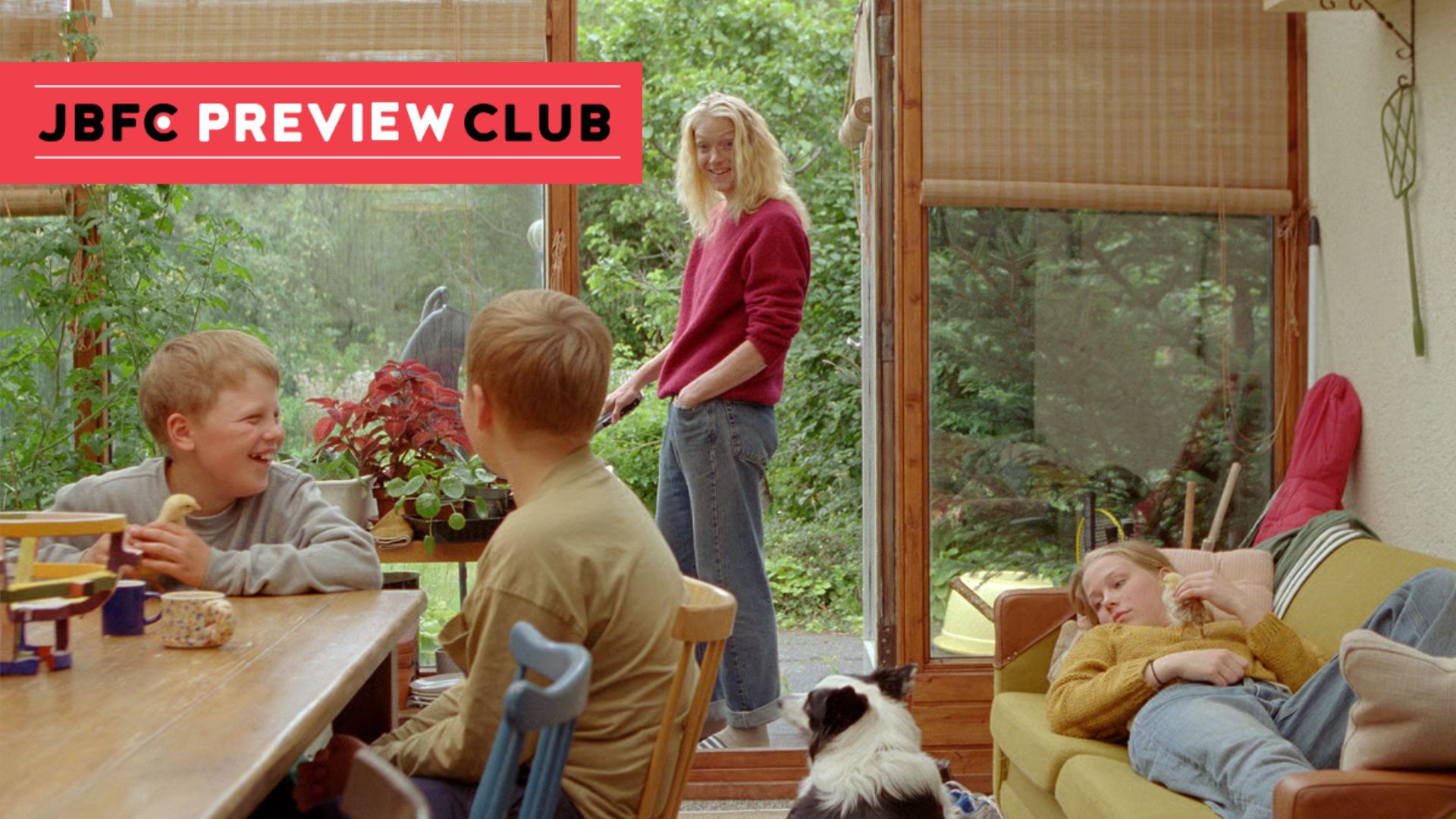
But, beyond the admittedly wonderful dog, I think that the greatest casting coup in the film is the three children, who are some of the best on-screen children I have seen in years, and are played so brilliantly by the director’s own sons and daughter. Pálmason has talked about how important it was for him to make the central family feel real and to make their world feel tangible and lived-in before the film starts to take on a more surreal, dream-like dimension. I appreciate how that shift toward the surreal feels so grounded in the interior life of the characters, their fears, and their desires—as opposed to just being a directorial flourish. The scene with the giant rooster made me laugh, to be sure, but it also made me feel for Magnus in a very real way (he was just trying to be helpful!).
I hope you enjoyed The Love That Remains, a film that moved and surprised me in equal measure. It was a pleasure, as always, to share it with you, and I look forward to seeing you next month!
Best,
Ian