
Posted January 12, 2026
The Choral: Preview Club Wrap-Up
by JBFC Director of Special Programs & Strategic Partnerships Chris Holliday
As part of the JBFC Preview Club, subscribers get an exclusive first look at the most interesting new indies and foreign films on our “New Releases” horizon. Every month, JBFC programmers present a special “secret” screening of an anticipated new film release before it is available to the public. After the screening, our programmers open the floor for a robust audience discussion and send Club members a wrap-up note with behind-the-scenes details and fun facts about the film they just watched.
As a special treat, we have decided to make these notes public. Beware, there may be spoilers!
Preview Club Wrap-up for The Choral, presented by JBFC Director of Special Programs & Strategic Partnerships Chris Holliday on Jan. 6, 2026:
Hello,
It was a pleasure to see everyone on Tuesday night and celebrate the start of a new season of Preview Club!
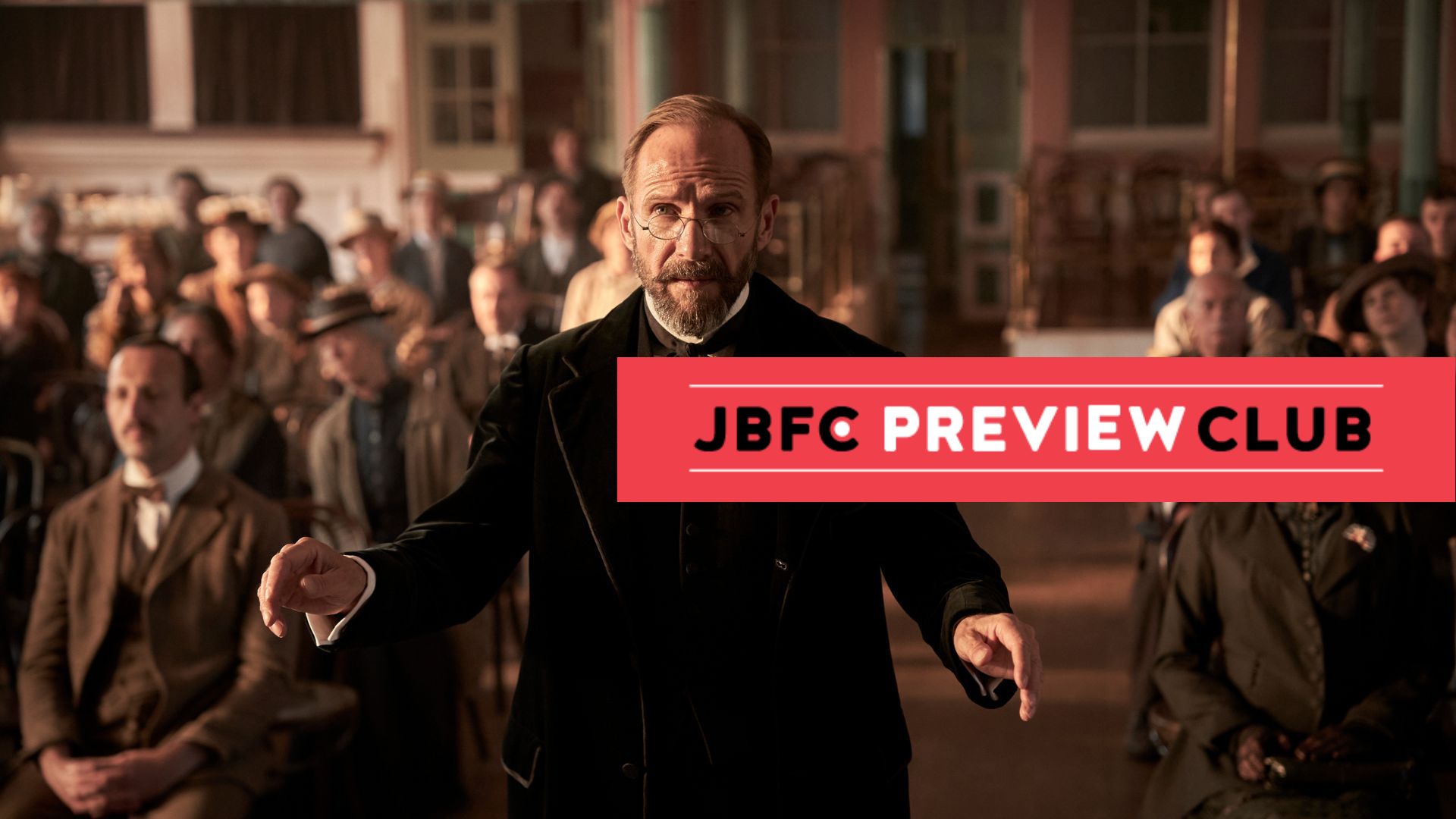
This month’s title was The Choral, which opens at the Burns today, courtesy of our friends at Sony Pictures Classics.
The Choral, directed by Nicholas Hytner and written by acclaimed British playwright Alan Bennett, had its world premiere at last year’s Toronto International Film Festival, where I was lucky enough to see it.
Alan Bennett, a national treasure in the UK, conceived the idea for the film during the lockdown of March 2020—a period in which many of us became acutely aware of the importance of both community and the arts, particularly as access to them was severely limited. These ideas form two of the film’s central themes: community and the transformative power of the arts—specifically music.
Typical of Bennett’s writing, The Choral reflects the realities of World War I in England, not through battlefield spectacle, but by showing how the war permeates everyday life in a small Yorkshire town. The story captures the social tensions of the time—such as suspicion of “German-linked” culture—while showing how people seek solace in collective pursuits like music, using choral singing to forge resilience and preserve a sense of unity amid the upheaval of war.
Alan Bennett and director Nicholas Hytner have collaborated on numerous projects over the years. Their partnership includes acclaimed stage works such as The History Boys, The Lady in the Van and The Madness of King George —all of which Hytner later directed as successful feature films. However, this was not the case with The Choral.
Hytner recognised early on that the structure and scope of the story were better suited to a cinematic format rather than a stage production, and so the film came into being.
From the start, authenticity was a guiding principle across every aspect of its creation—from casting and costumes to set design.
The village at the center of the story is fictional. However, production designer Peter Francis created a convincing Edwardian mill town through a combination of real locations and purpose-built sets. Saltaire, a UNESCO World Heritage Site, served as a primary filming location, lending historical credibility to the setting and the story.
The same commitment to authenticity is evident in the costume design. Costume designer Jenny Beavan, who won an Academy Award for her work on Merchant Ivory’s A Room with a View, brings extensive experience in period drama. I think you can really see her meticulous research and historical knowledge reflected in the costumes on screen.
Casting was another crucial element. Both Bennett and Hytner have spoken extensively about the importance of an ensemble cast for this project, with established actors such as Ralph Fiennes and Simon Russell Beale (his cameo as Elgar is a highlight for me!) appearing alongside relative newcomers such as Jacob Dudman (who plays Clyde, the returning soldier with the stunning voice), and Amara Okereke, as the Salvation Army singer Mary—and who did end up taking her bonnet off!
Hytner and casting director Robert Sterne placed particular emphasis on finding young talent from Yorkshire, where the story is set. Acting and musical ability were essential, but so too was a strong sense of humor. They were keen for the cast to gel both on and off screen—something that adds to the convincing sense that these characters live in the same village, sharing life and the wartime experience together.
Finally, of course, music plays a central role in the film. All of the actors trained as a choir, and it is their voices that we hear on screen. In addition, forty-five amateur singers from a local choral society were included, and three musical directors were involved to support the cast in performing the demanding musical pieces.
The film prominently features Edward Elgar’s “The Dream of Gerontius,” widely regarded as one of his greatest works, despite its initially poor reception. The piece explores themes of death, loss, and grief, mirroring the characters’ experiences in The Choral. Additional music heard throughout the film was arranged by George Fenton, known for his work on The Remains of the Day, Shadowlands, and, more recently, Ken Loach’s The Old Oak (a must-watch if you haven’t seen it!).
For me, it is the way all of these elements come together—Alan Bennett’s writing, Nicholas Hytner’s cinematic vision, the powerful music, and the dynamic ensemble cast—that gives The Choral its emotional impact and highlights just how important community and the arts are to our lives—a message just as true today as it was over a hundred years ago.
Ian will be back next month, but I hope to see you at the movies again soon! Have a lovely weekend.
Chris
The Choral is now playing at the JBFC Theater.