Posted March 10, 2026
My Father's Shadow: Preview Club Wrap-Up
by JBFC Film Programmer Ian LoCascio
As part of the JBFC Preview Club, subscribers get an exclusive first look at the most interesting new indies and foreign films on our “New Releases” horizon. Every month, JBFC programmers present a special “secret” screening of an anticipated new film release before it is available to the public. After the screening, our programmers open the floor for a robust audience discussion and send Club members a wrap-up note with behind-the-scenes details and fun facts about the film they just watched.
As a special treat, we have decided to make these notes public. Beware, there may be spoilers!
Preview Club Wrap-up for My Father’s Shadow, presented by JBFC Film Programmer Ian LoCascio on Mar. 3, 2026:
Thank you for a great Preview Club screening on Tuesday!
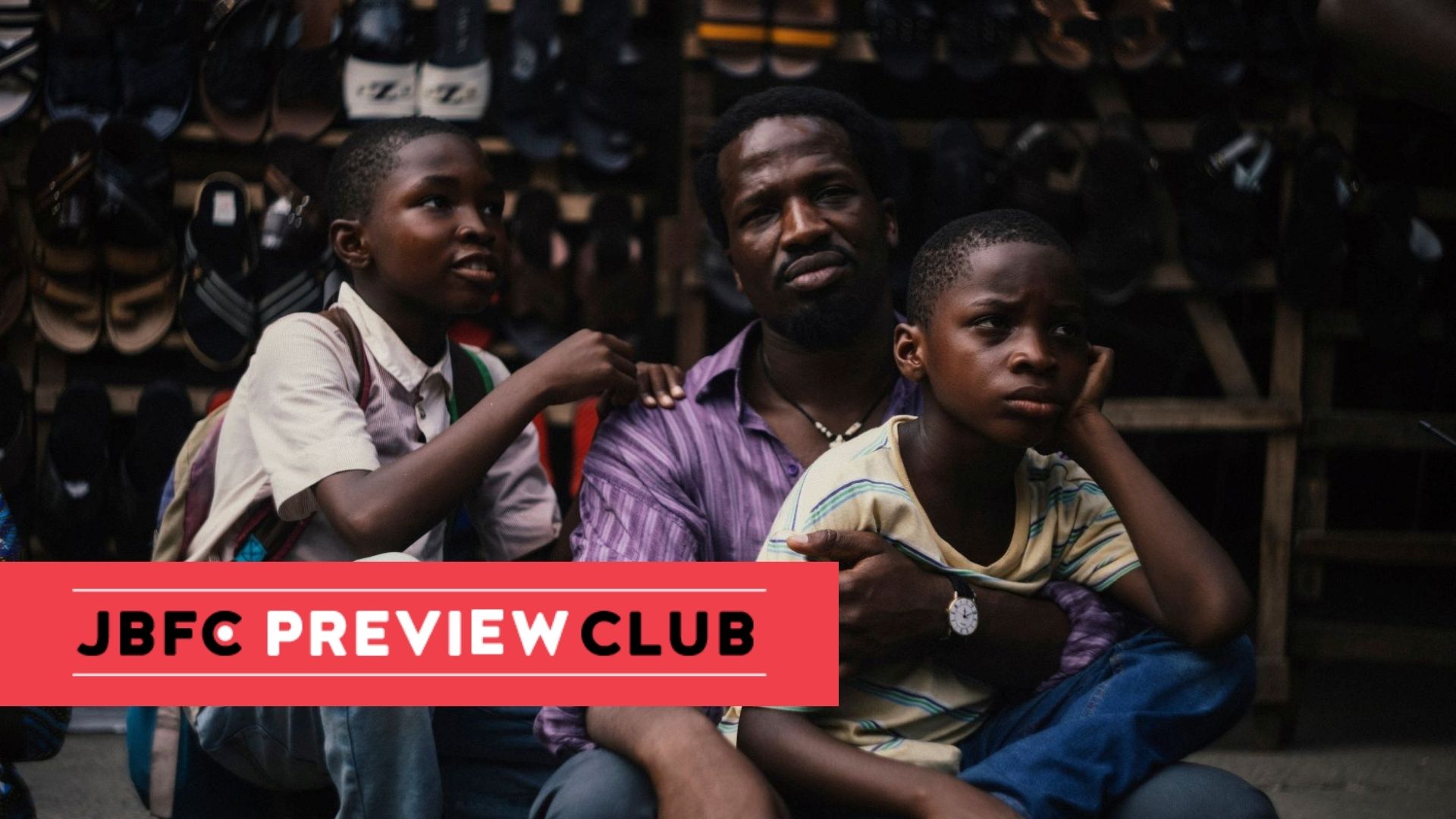
As a reminder, our March title was My Father’s Shadow, which we are opening at the Burns on March 27 courtesy of our friends at MUBI.
My Father’s Shadow is the debut feature from British-Nigerian filmmaker Akinola Davies Jr., who first gained recognition for his short film Lizard, which won the Grand Jury Prize at the 2021 Sundance Film Festival and went on to receive a nomination for Best Short Film at the BAFTA Awards that same year.
The gestation period for My Father’s Shadow predates Lizard by about five years and began with an idea for a film that Davies’ brother and co-writer, Wale Davies, had back in 2015. In the intervening years, the Davies brothers gradually wrote what would become the screenplay for My Father’s Shadow, with Akinola Davies Jr describing the writing process as having been largely comprised of “mini holidays” during which the two brothers were able to concentrate fully on writing. Wale Davies has reflected fondly on a number of those writing sessions spent in the Volta region of Ghana, where the two brothers would sit by the river as they wrote.
It is not coincidental that this film, written by two brothers, is one which centers on and is largely told from the perspective of two brothers; and, as the Davies Brothers acknowledge, there are prominent autobiographical elements present throughout the film.
Like the brothers in the film, Akinola and Wale Davies were primarily raised by their mother, and lost their father when they were young. They describe the film as having been inspired by the loss of their father, their memories of him, and the ways in which that loss has affected them in the years since his passing. Wale Davies describes himself and his brother as having been on “a journey to build a relationship with someone who is not there” and “trying to cling on to pieces of a person that is no longer present” adding that “all you have to build on are memories.”
There have been many great stories told across just about every medium which explore the idea of memory, but I think that film is uniquely suited to try and capture the active, visceral experience of remembering. This helps explain why so many of the greatest films about memory also stand as some of the greatest films of all time, full stop. Some examples I gave on Tuesday night included such classics as Citizen Kane, Vertigo, Rashomon, Hiroshima Mon Amour, and Wild Strawberries—but the list could, truly, keep going on and on.
A more contemporary “memory film” that My Father’s Shadow reminded me of is Scottish filmmaker Charlotte Wells’ debut feature Aftersun, which we showed at the Burns back in 2022 and for which Paul Mescal received a much-deserved Oscar nomination for Best Actor.
As with Aftersun, the visual and sonic language of My Father’s Shadow largely adopts the perspective of the children at its center—from the breezy magic of the amusement park and the terror and disorientation of the riot at the end of the film, to the hazy sense of confusion and uncertainty they feel as they see glimpses of their father’s life in Lagos and the larger socio-economic forces around them.
As you see in the film, the annulment of the 1993 presidential election was a very consequential moment in Nigerian politics and is considered the catalyst for the years of worsening political unrest that followed. Akinola Davies Jr was eight at the time of the election and his brother Wale was ten, and both have vivid memories of the day when the annulment was announced—which they drew upon in making the film.
It was important to Akinola Davies Jr that My Father’s Shadow was shot in Lagos, so that the film’s setting felt as alive as the city that he and his brother know and love. Wale Davies describes growing up in Lagos and seeing “little movie scenes” whenever he looked out his window and wanted the film to feature Lagos as a “living breathing character.”
The film was shot entirely on location, utilizing a substantial 27 different shooting locations across the city. One of the great challenges of making the film came from its production design, which required transforming these shooting locations back into how they looked in 1993. Lagos does not have many prop stores where the film team could source authentic props and costumes, so production designers Jennifer and Pablo Anti and costume designer PC Williams were required to do a lot of research and then individually source the bulk of the materials used to bring the film’s location to life.
I think My Father’s Shadow does a remarkable job of making the most of its location, and of blending the personal memories of the characters with the political memories of the country they live in. This is a film which really moved me, and I hope that it moved you too. It was, as always, a pleasure to rewatch it with you and to hear your thoughts after—and I look forward to seeing you next month!
Best,
Ian
My Father’s Shadow opens for a run at the JBFC Theater on Friday, March 27.