
Posted December 19, 2025
La Grazia: Preview Club Wrap-Up
by JBFC Film Programmer Ian LoCascio
As part of the JBFC Preview Club, subscribers get an exclusive first look at the most interesting new indies and foreign films on our “New Releases” horizon. Every month, JBFC programmers present a special “secret” screening of an anticipated new film release before it is available to the public. After the screening, our programmers open the floor for a robust audience discussion and send Club members a wrap-up note with behind-the-scenes details and fun facts about the film they just watched.
As a special treat, we have decided to make these notes public. Beware, there may be spoilers!
Preview Club Wrap-up for La Grazia, presented by JBFC Film Programmer Ian LoCascio on Dec. 9, 2025:
Thank you for a great conclusion to a great season of Preview Club!
It’s been a pleasure, and I look forward to returning as your host again next season!
As a reminder, subscriptions are now available for all levels of membership and are close to selling out—so be sure to order your subscription for next season if you have not yet done so.
Last night’s Preview Club film was La Grazia, and we’ll be opening it at the Burns on Dec. 19 courtesy of our friends at MUBI.
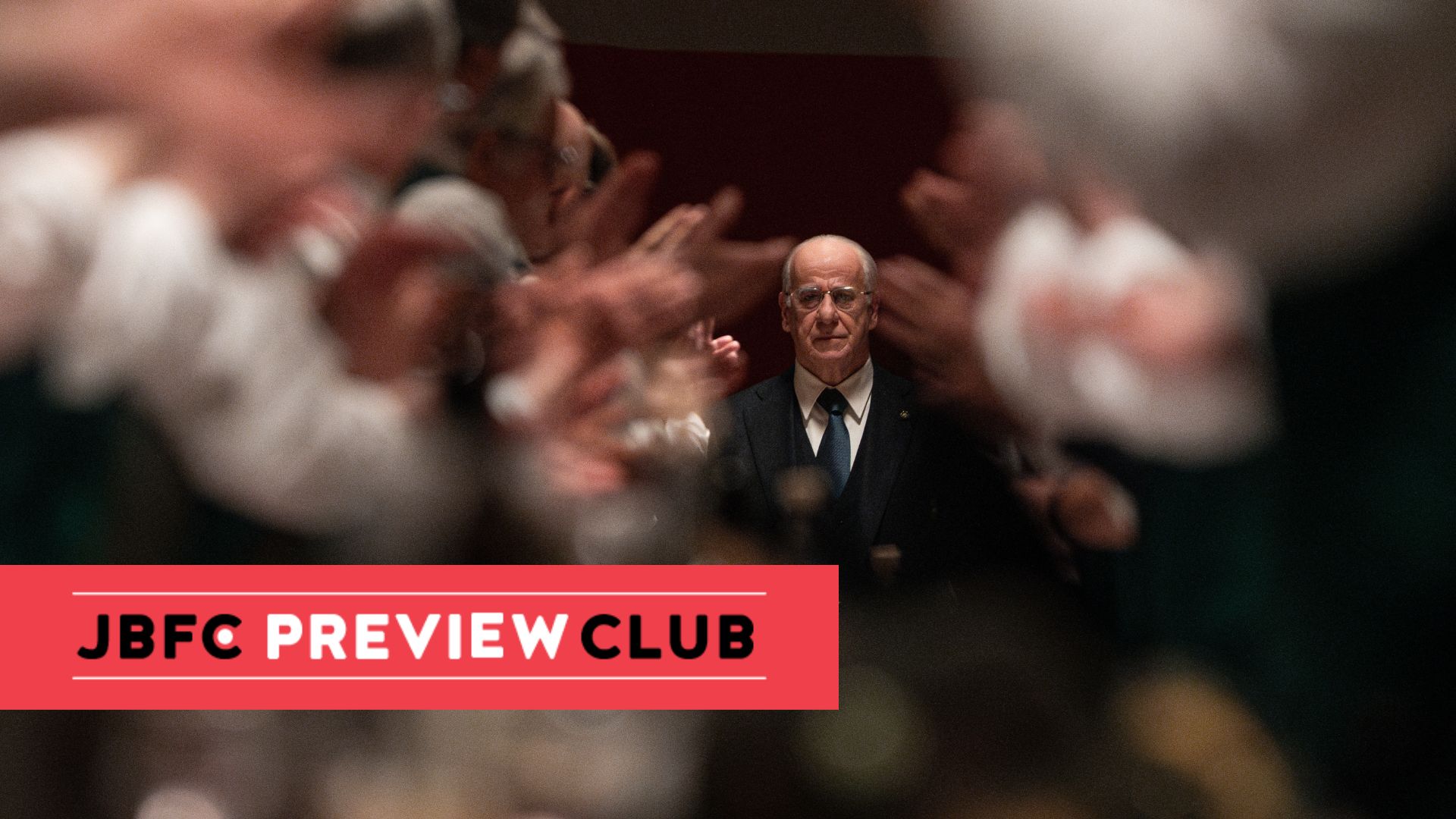
The film had its world premiere as the opening night selection of the Venice Film Festival earlier this year, and Toni Servillo, who plays the film’s fictional president Mariano De Santis, was given the award for Best Actor by the competition jury led by Alexander Payne, the director of such films as Sideways and The Holdovers.
La Grazia was directed by Paolo Sorrentino, one of the most significant and acclaimed contemporary Italian filmmakers. Sorrentino’s best known films include 2015’s The Great Beauty, which received the Academy Award for Best International Film, and 2021’s The Hand of God, which was nominated for the same award. Paolo Sorrentino came to the Burns for Q&As following screenings of both films, so there is a good chance that some of you saw him when he was here.
One of Sorrentino’s defining characteristics as a filmmaker is his distinct visual language, which is undeniably and unabashedly maximalist in nature. Far from the intimate close-ups of last month’s Preview Club selection Sentimental Value, Sorrentino is often drawn to long, wide shots of cavernous, ornate spaces—from the nightclubs of The Great Beauty to the presidential palace of La Grazia. On Tuesday, I talked about how the scene in which the Portuguese leader is nearly blown away by a sudden storm as he attempts to walk the red carpet, a scene mostly shot in slow motion and prominently featuring bass-heavy electronic music, feels like a quintessential Paolo Sorrentino scene.
With that said, one striking component of the visuals in La Grazia, especially compared to Sorrentino’s other work, is how empty those spaces feel. While there are some great supporting performances in La Grazia, especially from Anna Ferzetti, who plays President De Santis’ daughter Dorotea, so much of the film features De Santis in some degree of isolation, sequestered away from the country he is leading. As De Santis gazes down at the streets of Rome, smoking a cigarette alone on the mighty balcony of Italy’s Quirinal Palace, it’s no surprise that he seems to feel a sort of kinship with the weeping astronaut he later sees on the monitor.
Sorrentino’s protagonists often find themselves facing some kind of internal, existential dilemmas. I see a throughline from The Great Beauty’s protagonist Jep (who is sent into an existential crisis by the discovery that his first and only love, who recently passed away, had spent the past 35 years secretly loving him back) and La Grazia’s protagonist, De Santis, as the latter reckons with the fact that his late wife had cheated on him all those years before, and tries to discern the identity of the person she cheated with. While Jep takes his existential crisis to the streets of Rome, embarking on an extravagant odyssey of hedonism while reassessing the meaning of his life, the office of the presidency keeps De Santis largely confined to his palace, having to settle for listening to hip-hop songs through a pair of headphones instead of through club speakers.
Although La Grazia is a relatively subdued film from Sorrentino, it helps that he has such a dynamic leading man at the film’s center, an actor who I think is truly invaluable in his ability to bring pathos and emotional weight to what can be a rather heady, steely film. La Grazia marks the eighth time that Toni Servillo has worked with Paolo Sorrentino. In 2020, The New York Times included him on their list of the “best actors of the 21st century (so far)”, where he was recognized for his work with Sorrentino.
Servillo starred in The Great Beauty as that film’s aforementioned protagonist Jep, and he also starred in Sorrentino’s 2008 film Il Divo and his 2018 film Loro which, along with La Grazia, come together to form an interesting trilogy of sorts where Sorrentino trains his focus on Italian politics.
In Il Divo, which translates to “the star” or “the celebrity” but which derives from the Latin word “divus” meaning “God” or “Divine”, Toni Servillo plays former Italian Prime Minister Giulio Andreotti as he navigates a massive web of corruption, largely stemming from his connections to organized crime. Sorrentino has described the film as being “like a rock opera” about a politician who was, in his own way, a pop cultural icon.
In Loro, which translates to “them”, Servillo plays former Italian Prime Minister Silvio Berlusconi, with the titular “them” referring to the politicians and business leaders in his orbit, though the title can also be read as a play on “l’oro” which means “gold”. Berlusconi, a brash, charismatic media tycoon with a propensity for strongman tactics and the reputation for being able to maneuver past any scandal through sheer force of will was also a kind of pop cultural icon.
All of this is to say that the quiet, contemplative President Mariano De Santis, whom Toni Servillo describes as “allergic to being a showman,” stands in stark contrast to Sorrentino’s depictions of Andreotti and Berlusconi, two of the most polarizing leaders in modern Italian history.
President De Santis is, unlike Andreotti and Berlusconi, a fictional character, and Paolo Sorrentino describes him as being “a politician who is exactly the way I would like to see a politician to be.” If The Great Beauty was Sorrentino’s love letter to the city of Rome, and his previous film Parthenope is his love letter to his hometown of Naples, then La Grazia reads, to me, like Sorrentino’s love letter to the act of contemplation and to the embrace of uncertainty. This is something which feels increasingly rare amidst the political polarization of our present moment, which seeps from the upper echelons of power down to our own interpersonal lives.
The title of the film, La Grazia, which translates to “the grace” in English, is something which comes up a lot in the film, both within the context of the presidential pardon (which translates to “grazia” in Italian) but also in a more abstract sense. President De Santis’ line that “grace is the beauty of doubt” feels like a mission statement of sorts for the film, and it feels like a worthwhile note on which to end this season of Preview Club, and to carry you into the holidays.
It has been such a pleasure to be your Preview Club host this season, and I look forward to seeing you next year!
Stay warm,
Ian
La Grazia opens for a run at the JBFC Theater on Friday, Dec. 19.